{880}
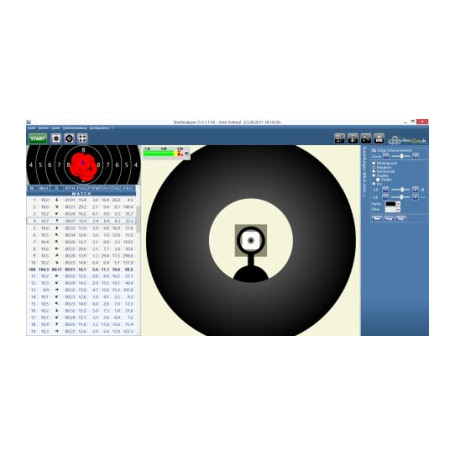
ShotAnalyzer offers 7 different games in the training area:
train the final sequence of a competition
{889}
{893}
try to stay above a set hit value for as long as possible
Reach the set target with the set number of shots
Game-set-win – play "shooting" tennis according to the generally applicable rules
mine a pyramid consisting of 5 levels and 15 shot values with a maximum of 30 shots
Final Simulator
The Final Simulator was developed to train the final sequence in training. All relevant ISSF commands and times were taken into account, so that a complete final can be simulated. The commands are always displayed and can also be played back by voice output. Currently, the commands are available in German and English.
Hint: the stored rules within the Final Simulator correspond to the ISSF rules after 2016
- Preparation and trial time: 8 minutes, unlimited number of shots
- a final match will be shot with 24 shots
- at the beginning of the final, two series of shots are fired with 3 shots each in 250 sec (shots 1-5 & 6-10)
- for shots 11-24, the shooter has 50 sec per shot, the shots are commanded individually
- after the 12th, 14th, 16th, 18th, 20th & 22nd shots, the shooter with the lowest overall score is eliminated
- if after the 12th, 14th, 16th, 18th, 20th & 22nd shots, the 2 weakest shooters have the same overall result, one or more jump-offs decide the progression
- Shots 23 and 24 are shot by the last 2 remaining shooters to determine the overall winner
- if the 2 last shooters have the same overall result after the 24th shot, one or more jumps decide the victory
Bundesliga Simulator
The game simulates an individual competition within the league system of the German Shooting Association. The shooter does not know which opponent he is shooting against, nor what result he has achieved and in what time. The selection of the opponent is made at random.
The game is intended to give the shooter the opportunity to compete in training against an opponent (man against man) who has shot a real competition in the Bundesliga or Regionalliga in the past. The opponent data is loaded with the help of an encrypted file (neither the name of the shooter nor the result of the competition is visible). The individual shots of the opponent are reproduced at the time intervals as they were fired in the competition at that time.
After a rehearsal time of a maximum of 15:00 minutes (rehearsal time can be shortened or skipped altogether if desired), the competition will start automatically after a 1-minute break (simulation of the control disc changes). A maximum competition time of 50:00 minutes is planned. If desired, the game can be interrupted at any time and resumed later.
Hint: The length of the trial period and competition period can be extended or shortened as desired. The above values of 15:00 minutes for trial and 50:00 minutes for competition are set by default.
If the shooter is finished before his opponent, the remaining shots of the opponent are displayed every 1 second.
Tenth
{930}
Example:
{932}
Program calculates a random hit constellation, which could be as follows:
- Value 10.6 => hit 4 times
- Value 10.4 => hit 20 times
- Value 10.3 => hit 8 times
- Value 10.0 = > hit 4 times
- Value 9.8 = > hit 4 times
The shooter only concentrates on hitting the individual hit values with the specified number. If he manages to do this, he can be sure that the desired overall result will be achieved or surpassed with a better hit pattern.
Psychology: The shooter should no longer think from series to series, but constantly achieve a small success by being able to cross out individual hits. The shooter no longer gets bogged down in the thought that he has to score a 103.0 per series, for example. You quickly notice that the psychological pressure decreases. Some shooters get into the competition better with this method (topic: starting problems when switching from trial to scoring)
Stay on top of it
This game is designed to challenge the shooter to stay above a preset hit value for as long as possible. If he does not reach the "limit value", he must exceed the set "rescue value" in the next shot. If the shooter cannot reach the "rescue value", the game is over.
High score:
There is not only a high score, but a corresponding high score is managed for every possible combination of threshold, rescue value and number of shots. Thus, every shooter can increase a high score step by step according to his performance level.
Tip:
With the help of this game, you can train the new tenth ranking, which is shot internationally. The advantage is that you get a feel for the new counting method, because you have the tenths of the sum of the respective 10 series at a glance.
Reach the goal
The game called "Reach the Target" was developed to set a challenge for the shooters. The game is designed in such a way that you can enter both full and comma-based results.
Example:
As a coach, I know roughly what my shooter's performance is and sets a final result accordingly. This can be a series of 10 or a whole competition (e.g. 40 shots). The game is over when the number of preset shots is reached.
However, you also have the option of starting the game again with the same value if you have not reached the corresponding value. Thus, one could count the attempts, how many attempts the shooter needed for the final result.
Tennis
Goal of the game?
The aim of the game is to win the match in a predetermined number of sets. The generally valid counting rules of tennis apply. For example, if both players have won 2 sets with a preset 3 winning sets, a tie-break is played, which decides the match.
How is a point scored?
A point is awarded if the opponent can no longer keep the "ball" in play. can play back. The "ball" is played back if the player has scored the same or higher shot value than his opponent.
Example: The shooter has the serve. The first shot is a 10.2. The opponent must now score at least a 10.2 to stay in the game and play the "ball" back. For example, if the opponent scores a 10.5, the shooter must score at least a 10.5 or higher on his second shot, etc. If the opponent scores less than 10.2, the point goes to the shooter.
How do you win a set?
Points must be scored within a set, with a player's first point being counted as 15, the second as 30 and the third as 40. A fourth point win decides the set, as long as the winner has a lead of two points. With a score of 40:40, one speaks of a debut. The game continues until a player has an "advantage" and can also win the following point.
Who has the "serve"?
The right to serve belongs to a player alone within a set. The shooter always serves first. Then it switches to the computer or opponent.
How does a tie-break work?
In the tie-break, every mistake is counted as a point, the counting method with 15, 30, 40 points is omitted. A tie-break is won when a player wins at least seven points and has at least a two-point lead. The right to serve changes after two serves.
Pyramid
A pyramid with 5 levels and a total of 15 shot values is built. The first level consists of 5 shot values to be achieved, the second of four, the third of three, the fourth of two, and the top or fifth level of only one shot value. The shot value increases by 0.1 rings in ascending or descending order – depending on the preset.
Goal of the game?
The aim of the game is to clear the pyramid completely. The shooter has a maximum of 30 shots to clear all the building blocks. If the pyramid is not cleared after 30 shots, the shooter has lost the game.
How is a building block extracted from the pyramid?
- If a shooter makes a hit that corresponds to one of the pyramid stones, then a stone is randomly removed from the corresponding row and the shot is marked green.
- If a shooter makes a hit that is less than the minimum value of the stones still to be mined, then this shot is marked in red and no pyramid stone is removed.
- {971}
Example: The shooter hits a 10.7. Within the pyramid stones still to be mined, there are no values of 10.7 or higher. The highest value is a 10.5 – so this building block is removed from the pyramid.
High score:
For each possible combination from which the pyramid can be built, there is a separate high score. A corresponding high score is stored for each minimum value. A distinction is also made between whether the pyramid was built inversely or not. Thus, everyone can increase the high score step by step according to their performance level.